
Featured Posts

- Index of Psychological Studies of Presidents and Other Leaders Conducted at the Unit for the Study of Personality in Politics
- The Personality Profile of U.S. Supreme Court Associate Justice Brett Kavanaugh
- The Leadership Style of North Korean Leader Kim Jong-un
- North Korea Threat Assessment: The Psychological Profile of Kim Jong-un
- Russia Threat Assessment: Psychological Profile of Vladimir Putin
- The Personality Profile of 2016 Republican Presidential Candidate Donald Trump
- Donald Trump's Narcissism Is Not the Main Issue
- New Website on the Psychology of Politics
- Unit for the Study of Personality in Politics --- 'Media Tipsheet'
categories
- Afghanistan (228)
- Al Gore (2)
- Amy Klobuchar (4)
- Ayman al-Zawahiri (7)
- Barack Obama (60)
- Ben Carson (2)
- Bernie Sanders (7)
- Beto O'Rourke (3)
- Bill Clinton (4)
- Bob Dole (2)
- Campaign log (109)
- Chris Christie (2)
- Chuck Hagel (7)
- Criminal profiles (8)
- Dick Cheney (11)
- Domestic resistance movements (21)
- Donald Trump (31)
- Economy (33)
- Elizabeth Warren (4)
- Environment (24)
- George H. W. Bush (1)
- George W. Bush (21)
- Hillary Clinton (9)
- Immigration (39)
- Iran (43)
- Iraq (258)
- Jeb Bush (3)
- Joe Biden (13)
- John Edwards (2)
- John Kasich (2)
- John Kerry (1)
- John McCain (7)
- Kamala Harris (5)
- Kim Jong-il (3)
- Kim Jong-un (11)
- Law enforcement (25)
- Libya (18)
- Mahmoud Ahmadinejad (6)
- Marco Rubio (2)
- Michael Bloomberg (1)
- Michele Bachmann (173)
- Mike Pence (3)
- Military casualties (234)
- Missing person cases (37)
- Mitt Romney (13)
- Muqtada al-Sadr (10)
- Muslim Brotherhood (6)
- National security (16)
- Nelson Mandela (4)
- News (5)
- North Korea (36)
- Osama bin Laden (19)
- Pakistan (49)
- Personal log (25)
- Pete Buttigieg (4)
- Presidential candidates (19)
- Religious persecution (11)
- Rick Perry (3)
- Rick Santorum (2)
- Robert Mugabe (2)
- Rudy Giuliani (4)
- Russia (7)
- Sarah Palin (7)
- Scott Walker (2)
- Somalia (20)
- Supreme Court (4)
- Syria (5)
- Ted Cruz (4)
- Terrorism (65)
- Tim Pawlenty (8)
- Tom Horner (14)
- Tributes (40)
- Uncategorized (50)
- Vladimir Putin (4)
- Xi Jinping (2)
- Yemen (24)
Links
archives
- November 2021
- January 2021
- November 2020
- October 2020
- September 2020
- August 2020
- July 2020
- April 2020
- March 2020
- February 2020
- January 2020
- December 2019
- October 2019
- July 2019
- May 2019
- April 2019
- March 2019
- February 2019
- January 2019
- December 2018
- September 2018
- August 2018
- July 2018
- June 2018
- April 2018
- March 2018
- February 2018
- January 2018
- August 2017
- July 2017
- June 2017
- May 2017
- April 2017
- February 2017
- January 2017
- December 2016
- November 2016
- October 2016
- September 2016
- August 2016
- July 2016
- June 2016
- May 2016
- April 2016
- March 2016
- February 2016
- January 2016
- December 2015
- November 2015
- October 2015
- September 2015
- August 2015
- July 2015
- June 2015
- May 2015
- April 2015
- March 2015
- February 2015
- January 2015
- December 2014
- November 2014
- October 2014
- September 2014
- August 2014
- July 2014
- June 2014
- May 2014
- April 2014
- March 2014
- February 2014
- January 2014
- December 2013
- November 2013
- October 2013
- September 2013
- August 2013
- July 2013
- June 2013
- May 2013
- April 2013
- March 2013
- February 2013
- January 2013
- December 2012
- November 2012
- October 2012
- September 2012
- August 2012
- July 2012
- June 2012
- May 2012
- April 2012
- March 2012
- February 2012
- January 2012
- December 2011
- November 2011
- October 2011
- September 2011
- August 2011
- July 2011
- June 2011
- May 2011
- April 2011
- March 2011
- February 2011
- January 2011
- December 2010
- November 2010
- October 2010
- September 2010
- August 2010
- July 2010
- June 2010
- May 2010
- April 2010
- March 2010
- February 2010
- January 2010
- December 2009
- November 2009
- October 2009
- September 2009
- August 2009
- July 2009
- June 2009
- May 2009
- April 2009
- March 2009
- February 2009
- January 2009
- December 2008
- November 2008
- October 2008
- September 2008
- August 2008
- July 2008
meta
‘Adapt or Die’ Becomes Mantra Against Warming
Some species adjust, but humans hampered by costs and speed of change

The Thames Barrier has 10 steel gates that protect London from tidal surges but, fearing rising seas from global warming, Britain is investing $500 million to beef up those defenses. (Photo credit: Leon Neal / AFP — Getty Images file)

December 3, 2009
With the world losing the battle against global warming so far, experts are warning that humans need to follow nature’s example: Adapt or die. That means elevating buildings, making taller and stronger dams and seawalls, rerouting water systems, restricting certain developments, changing farming practices and ultimately moving people, plants and animals out of harm’s way.
Adapting to rising seas and higher temperatures is expected to be a big topic at the U.N. climate-change talks in Copenhagen next week, along with the projected cost — hundreds of billions of dollars, much of it going to countries that cannot afford to do it themselves. That adaptation will be a major focus is remarkable in itself.
Until the past couple of years, experts avoided talking about adjusting to global warming for fear of sounding fatalistic or causing countries to back off efforts to reduce emissions. …
Some biologists point to how nature has handled the changing climate. The rare Adonis blue butterfly of Britain looked as if it was going to disappear because it couldn’t fly far and global warming was making its habitat unbearable. To biologists’ surprise, it evolved longer thoraxes and wings, allowing it to fly farther to cooler locales.
“Society needs to be changing as much as wildlife is changing,” said Texas A&M biologist Camille Parmesan, an expert on how species change with global warming.
Change too fast to adapt?
One difficulty is that climate change is happening rapidly.
“Adaptation will be particularly challenging because the rate of change is escalating and is moving outside the range to which society has adapted in the past” when more natural climate changes happened, U.S. National Oceanic and Atmospheric Administration chief Jane Lubchenco, a marine biologist, told Congress on Wednesday.
Cities, states and countries are scrambling to adapt or are at least talking about it and setting aside money for it. Some examples:
- England is strengthening the Thames River flood control barrier at a cost of around half a billion dollars.
- The Netherlands is making its crucial flood control system stronger.
- California is redesigning the gates that move water around the agriculturally vital Sacramento River Delta so that they can work when the sea level rises dramatically there.
- Boston elevated a sewage treatment plant to keep it from being flooded when sea level rises. New York City is looking at similar maneuvers for water plants.
- Chicago has a program to promote rooftop vegetation and reflective roofs that absorb less heat. That could keep the temperature down and ease heat waves.
- Engineers are installing “thermal siphons” along the oil pipeline in Alaska, which is built on permafrost that is thawing, to draw heat away from the ground.
- Researchers are uprooting moisture-loving trees along British Columbia’s coastal rainforests and dropping their seedlings in the dry ponderosa pine forests of Idaho, where they are more likely to survive.
- Singapore plans to cut its flood-prone areas in half by 2011 by widening and deepening drains and canals and completing a $226 million dam at the mouth of the city’s main river.
- In Thailand, there are large-scale efforts to protect places from rising sea levels. Monks at one temple outside Bangkok had to raise the floor by more than 3 feet.
- Desperately poor Bangladesh is spending more than $50 million on adaptation. It is trying to fend off the sea with flood control and buildings on stilts.
President Barack Obama and Congress are talking about $1.2 billion a year from the U.S. for international climate aid, which includes adaptation. …
The World Bank estimates adaptation costs will total $75 billion to $100 billion a year over the next 40 years. The International Institute for Environment and Development, a London think tank, says that number is too low.
It may even be $200 billion a year or $300 billion a year, said Chris Hope, a business school professor at the University of Cambridge and part of the IIED study. Nevertheless, Hope said failing to adapt would be even more expensive — perhaps $6 trillion a year on average over the next 200 years. Adaptation could cut that by about $2 trillion a year, he said. …
‘Planned relocation’ ahead?
As for helping plants and animals, British climate scientist Martin Parry said the world will have to create a triage system to figure out which living things can be saved, which can’t and are effectively goners, and which don’t need immediate help. …
|

Some islands, such as the Maldives, and some coastal cities will not be able to survive rising seas no matter what protections are put in place, said Saleemel Huq, a senior fellow at IIED who runs an adaptation center in Bangladesh.
In those cases, he said, the world will need “planned relocation” of people and cities.
Parmesan said people are going to have to realize that “some areas are not going to be good enough to live in in the next 100 years.”
———————————————————
Related reports: “Climategate”
Scientist in climate flap to step down for now (AP, Dec. 2, 2009)
Climate e-mails debated at House hearing (AP, Dec. 2, 2009)
University in climate flap details inquiry reach (AP, Dec. 3, 2009)
Penn State prof welcomes climate flap inquiry (AP, Dec. 3, 2009)
United Nations to probe climate e-mail leak (AP, Dec. 3, 2009)
————————————
12/12/2009 Update
Review: E-mails Show Pettiness, Not Fraud
By Seth Borenstein, Raphael Satter and Malcolm Ritter
December 12, 2009
LONDON — E-mails stolen from climate scientists show they stonewalled skeptics and discussed hiding data — but the messages don’t support claims that the science of global warming was faked, according to an exhaustive review by The Associated Press.
The 1,073 e-mails examined by the AP show that scientists harbored private doubts, however slight and fleeting, even as they told the world they were certain about climate change. However, the exchanges don’t undercut the vast body of evidence showing the world is warming because of man-made greenhouse gas emissions.
The scientists were keenly aware of how their work would be viewed and used, and, just like politicians, went to great pains to shape their message. …
Some e-mails expressed doubts about the quality of individual temperature records or why models and data didn’t quite match. Part of this is the normal give-and-take of research, but skeptics challenged how reliable certain data was. …
The AP studied all the e-mails for context, with five reporters reading and rereading them — about 1 million words in total. …
———————————————
2/26/2011Â Related report
New Report Exonerates U.S. Climate Researchers
By Randolph E. Schmid
February 24, 2011
WASHINGTON — A Commerce Department investigation has found no evidence of wrongdoing on the part of U.S. climate researchers whose e-mails were leaked in the debate over global climate change.
The report Thursday from the department’s inspector general is the latest to exonerate climate scientists whose communications with the Climate Research Unit at England’s University of East Anglia were stolen and made public in 2009. The department reviewed all 1,073 leaked e-mails, but focused on 289 that involved National Oceanic and Atmospheric Administration scientists.
Mary Glackin, NOAA’s deputy undersecretary for operations, said she welcomed the report since “none of the investigations have found any evidence to question the ethics of our scientists or raise doubts about NOAA’s understanding of climate change science.”
Climate change skeptics have sought to characterize some of the e-mails as indicating scientists failed to follow proper procedures or altered data. Investigations in both England and by the National Research Council and Pennsylvania State University in the United States have also concluded that there was no indication of scientific impropriety.
The new report did question the handling of some freedom of information requests by NOAA and asked the agency to review the circumstances under which funds were transferred to the British researchers. Glackin said the money was used for workshops that assisted the governments of Cambodia, Laos and Vietnam in improving their climate forecasting work. …
———————————————
Related link

———————————————
1/5/2010 Update
Related reports:
C.I.A. is sharing data with climate scientists (William J. Broad, New York Times, Jan. 5, 2010) — The nation’s top scientists and spies are collaborating on an effort to use the federal governments intelligence assets to assess the hidden complexities of environmental change. In October 2009, the C.I.A. opened a small unit to assess the security implications of climate change.
Climate change seen as threat to U.S. security (John M. Broder, New York Times, Aug. 9, 2009) — A growing number of policy makers say that the world’s rising temperatures, surging seas and melting glaciers are a direct threat to the national interest.
Spy chief backs study of impact of warming (Mark Mazzetti, New York Times, May 12, 2007) — The United States top intelligence official has endorsed a study by spy agencies about the impact of global warming on national security.
Terror in the weather forecast (Thomas Homer-Dixon, New York Times, Apr. 24, 2007) — Climate stress may well represent a challenge to international security just as dangerous and more intractable than the arms race between the United States and the Soviet Union during the cold war.
———————————
1/19/2010 Update
2000s Warmest Decade on Record
January 19, 2010
WASHINGTONÂ — The 2000-2009 decade was the warmest on record, easily surpassing the previous hottest decade — the 1990s — researchers said Tuesday in a report providing fresh evidence that the planet may be warming at a potentially disastrous rate.
In 2009, global surface temperatures were 1.01 degree above average, which tied the year for the fifth warmest year on record, the National Climatic Data Center said.
And that helped push the 2000-2009 decade to 0.96 degree above normal, which the agency said “shattered” the 1990s record value of 0.65 degree above normal.
The warmest year on record was 2005 at 1.11 degrees above normal.
The findings follow years of gradually rising global temperatures which atmospheric scientists attribute to the warming effect of gases released into the air by human activities, including burning fossil fuels. …
Concerns about the effects of a warmer climate include rising sea levels and the potential spread of tropical diseases, changes in hurricane patterns, increased drought in some areas, disruption of crop growth and wildlife patterns, and loss of species unable to adapt. …
Last year’s climate milestones included:
- The 10th consecutive summer with above-normal temperatures in the U.S. Northwest.
- Record winter drought in Texas.
- The deadliest February tornado in Oklahoma history.
- The largest wildfire in Los Angeles County history.
- Most active tornado season in a decade in Louisiana and Alabama.
- New seasonal snowfall records for Spokane, Wash., and International Falls, Minn.
- Worst deluge in decades in northern Brazil, affecting 186,000 people.
- Heavy rainfall in northern Argentina, causing a landslide affecting 20,000 people.
- Disastrous floods triggered by heavy rain in Central Europe.
- Britain’s heaviest snowstorm since 1991.
- Extratropical storm Klaus (similar to a category 3 hurricane) kills 30 in France and Spain.
- Heaviest snowfall in northern China in 55 years.
- Typhoons batter the Philippines causing fatal flooding.
- More than 600 die in the deadliest typhoon to hit Taiwan in five decades.
———————————
8/13/2010 Update
What’s Behind the Weather Chaos?
By Brandon Miller
CNN Meteorologist

August 12, 2010
Is the record-shattering heatwave that has been blamed for the deaths of thousands in Russia somehow related to the devastating flooding in Pakistan?
Are these disasters happening more frequently — and are they a result of global warming? …
Muscovites will long remember the summer of 2010 as the hottest and most extreme weather summer in the city’s long history. The all-time temperature record was set, and re-set, five different times during a two-week span from late July to early August. In that period the temperature climbed above 30 degrees Celsius (87 degrees Fahrenheit) for 29 consecutive days (and still counting).
In addition to the extreme heat, which reached up to 39 degrees Celsius (102 degrees Fahrenheit) on multiple days in a city that averages an August high of 22 degrees Celsius (72 degrees Fahrenheit), the capital was shrouded in a thick layer of smoke from area wildfires.
The combination of extreme heat and lack of rainfall left western Russia vulnerable to wildfires, which burned out of control southeast of Moscow.
Nearly 4,000 kilometers (2,485 miles) away in Pakistan, monsoon rains fell with an intensity that had never before been observed.
Peshawar, a city in northern Pakistan 140 km (87 miles) west of the capital Islamabad, received six times the monthly average rainfall in only 24 hours.
Heavy rain has continued to occur throughout Pakistan since the initial heavy downpour on July 29, and the flooding has impacted an estimated 14 million people, killing over 1,300 at time of writing. …
As we continually stress, one extreme weather event, or even a series of weather events, is not caused by global warming or climate change. Weather extremes such as floods or heat waves happen every year, all over the globe.
Many climate scientists believe, however, that these events will become more common, as the Earth warms because of global warming. Others will point to more distinct and shorter-scale cycles such as El Nino and La Nina, which commonly lead to extremes in weather around the globe.
So, while we can tie many of these global weather disasters together around a common meteorological trigger, we cannot say for certain if climate change is helping to pull that trigger, or perhaps loading the gun more frequently. …
———————————
12/4/2010 Update
Last Decade Warmest on Record, Review Finds
U.N. agency also says 2010 could be single warmest year on record
The Associated Press and Reuters via MSNBC.com
December 2, 2010
CANCUN, Mexico — This last decade was the warmest since temperature records began in 1850, the U.N.’s World Meteorological Organization said Thursday in a review issued on the sidelines of U.N. talks in Mexico that are seeking ways to rein in global warming.
“Recent warming has been especially strong in Africa, parts of Asia, and parts of the Arctic,” it said in a statement. “The Saharan/Arabian, East African, Central Asian and Greenland/Arctic Canada sub-regions have all had 2001-10 temperatures 1.2 to 1.4 degrees C (about 2 degrees Fahrenheit) above the long-term average, and 0.7 degrees C to 0.9 degrees C (about 1.5 F) warmer than any previous decade.”
While no single weather event can be traced to human activity and greenhouse gases, WMO Secretary-General Michel said natural variation cannot explain the decade-long record. “If you don’t take the human emission into account you cannot reproduce what you observe,” he said.
Moreover, Jarraud said there is a “significant possibility 2010 could be the warmest” year on record, surpassing 1998 and 2005.
The British Met Office — one of the three main groups that compiled the data that was then peer-reviewed — said 2010 was “more likely than not” the warmest year.
A final review in early 2011 will determine 2010’s place, though there is still a chance 2010 will be just below 1998 and 2005 if December cools, the WMO stated.
The WMO said that land and sea surface temperatures so far in 2010 were 0.55 degrees C (1 F) above a 1961-1990 average of 14 degrees C (57.2 F).
“Major regional climate events” this year, it said, were:
- Extreme Asian summer monsoon in some areas;
- Extreme summer heatwaves in Russia and other areas;
- An abnormal winter in many parts of the Northern Hemisphere;
- Heavy rains and flooding in Indonesia, Australia, Africa, Europe and South America;
- Drought in the Amazon and elsewhere;
- El Nino in early 2010, then La Nina by year-end;
- Hurricane activity well below normal, except in the North Atlantic;
- Third-lowest recorded minimum for Arctic summer sea ice.
———————————
1/13/2011 Update
2010 Tied as Warmest Year Globally on Record, U.S. Says
It was also the 34th consecutive above average year — and the wettest on record

Reuters via MSNBC.com
January 12, 2011
WASHINGTON — Last year tied for the warmest globally since records began, the U.S. agency that tracks temperatures said on Wednesday, capping a decade of record high temperatures and raising concerns about more storms and floods related to climate change.
Combined global land and ocean temperatures in 2010 were 1.12 degrees Fahrenheit above the 20th century average, tying the record set in 2005, the National Climatic Data Center, an office of the National Oceanic and Atmospheric Administration, said in a release.
“These results show that the climate is continuing to show the influence of greenhouse gases, it’s showing evidence of warming,” David Easterling, the chief of the scientific services division at the NCDC, told reporters.
Other facets pointed out by NOAA:
- 2010 was the 34th consecutive year with global temperatures above the 20th century average.
- 2010 was also the wettest year on record in terms of global average precipitation.
- Each year since 2000 has ranked as one of the 15 warmest years on record since 1880 when the records began.
- For the U.S. mainland, the 2010 average annual temperature was the 14th consecutive year above average and the 23rd warmest year on record.
Despite last year’s frigid temperatures and snow storms in the United States and Europe many places, such as Russia and Pakistan, suffered from heat waves and floods that wrecked crops and helping lead to record global food prices.
It’s not possible to link one weather event directly to global warming, but the trend of rising temperatures since 2000 increases the possibility that such events will happen, Easterling said. …
——————————
4/4/2012 Update
This March Was the Warmest on Record
By Dave Aeikens
St. Cloud Times
April 3, 2012
March 2012 was the warmest on record in St. Cloud [Minnesota], setting numerous daily records along the way, according to the National Weather Service.
Monthly records for average and mean temperature were set and the average high was the second warmest in history. The marks toppled records set in 1910.
In addition, St. Cloud recorded seven cooling degrees days, counted when the temperture exceeds 65 degrees. St. Cloud had not previously recorded a cooling degree day in March, according to the National Weather Service.
“It is pretty extreme to get that kind of heat this early in the year,†said Ross Carlyon, a meteorlogical technician for the National Weather Service.
The average low was 33.5 degrees, which was almost 20 degrees above normal. The mean temperature was 44 degrees, which was 14.6 degrees above normal.
In March, 15 daily records were set including the high temperature seven times and the warmest low temperature seven times.
The temperature reached 78 on March 18, one of six days on which the temperature passed 70 degrees. It passed 60 14 times and 50 21 times. A normal March brings six days days above 50, two above 60 and none above 70.
The low was 59 on March 19, breaking the record by 20 degrees.
The warm March follows what was the warmest winter – December, January and February- in St. Cloud history.
Warm March
Here is a list of warm temperature records set in March [2012].
| Date | Record | Temperature | Old | Date |
| March 11 | high | 61 | 60 | 1901, 1902 |
| March 14 | high | 71 | 65 | 1981 |
| March 15 | high | 65 | 64 | 1935 |
| March 16 | high | 76 | 63 | 1930 |
| March 17 | high | 75 | 68 | 1894 |
| March 17 | warm low | 51 | 42 | 1968 |
| March 18 | high | 75 | 70 | 1910 |
| March 18 | warm low | 61 | 46 | 1968 |
| March 19 | high | 78 | 71 | 1910 |
| March 19 | warm low | 59 | 39 | 1921 |
| March 20 | warm low | 50 | 37 | 1938 |
| March 21 | warm low | 50 | 43 | 1938 |
| March 22 | warm low | 53 | 40 | 1910 |
| March 23 | warm low | 53 | 43 | 1910 |
Source: National Weather Service
—————————
Topical report
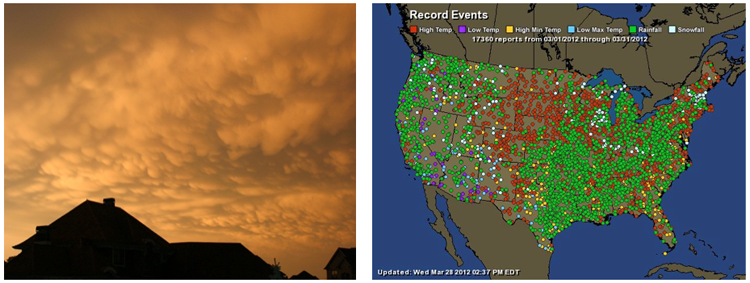
A message from a Republican meteorologist on climate change
(Paul Douglas, The Huffington Post, March 29, 2012) — I’m going to tell you something that my Republican friends are loath to admit out loud: climate change is real. I’m a moderate Republican, fiscally conservative; a fan of small government, accountability, self-empowerment and sound science. I am not a climate scientist. I’m a Penn State meteorologist, and the weather maps I’m staring at are making me very uncomfortable. No, you’re not imagining it: we’ve clicked into a new and almost foreign weather pattern. … Full story
———————————
7/25/2012 Update
Ice Melt Found Across 97 Percent of Greenland, Satellites Show

About 40 percent of Greenland’s ice sheet thawed at or near the surface on July 8, 2012. Four days later, the melt had dramatically accelerated and an estimated 97 percent of the ice sheet surface had thawed. (Image credit: Nicolo E. DiGirolamo, SSAI/NASA GSFC, and Jesse Allen, NASA Earth Observatory via MSNBC.com)
By Miguel Llanos

July 24, 2012
Three satellites found that 97 percent of Greenland — the land mass second only to Antarctica for its volume of ice — underwent a thaw never before seen in 33 years of satellite tracking, NASA reported Tuesday.
Satellite experts at first didn’t trust their readings, especially since they showed an incredible acceleration. Over four days, Greenland’s ice sheet — which covers 683,000 square miles — went from 40 percent in thaw to nearly entirely in thaw. …
Ice cores from Greenland’s highest region do reveal that such island-wide thaws have happened every 150 years or so, at least over the last few thousand years, but the fear now is that it might occur much more frequently due to warming sea and air temperatures. …
———————————
8/28/2012 Update
‘A Less Polar Pole’: Arctic Sea Ice at Record Low

This visualization shows the extent of Arctic sea ice on Aug. 26, 2012, the smallest area in three decades of satellite records. The yellow line shows the average minimum summer ice coverage from 1979 to 2010. (Image: NBC News)
By Miguel Llanos
August 27, 2012
The amount of summer sea ice in the Arctic has reached a record low in three decades of satellite data, scientists reported Tuesday, with one of them describing recent warm years there as creating a “less polar pole.” The decline was expected to continue for at least several more days before cold weather sets in and creates new ice through fall and winter.
The area of Arctic waters covered by sea ice was measured at 1.58 million square miles on Sunday, the National Snow and Ice Data Center (NSIDC) reported. That’s below the previous record low of 1.61 million square miles set on Sept. 18, 2007, and in line with earlier expectations for the season.
“Including this year, the six lowest extents in the satellite record have occurred in the last six years,” the center noted on its website. …
Ted Scambos, a senior NSIDC researcher, told NBC News that no one weather pattern explains the downward trend. “Greenhouse gasses are the only consistent explanation for a persistently warming Arctic,” he added. …
———————————
11/30/2012 Update
Antarctica, Greenland Ice Definitely Melting into Sea, and Speeding Up, Experts Warn
 Video
Video
Polar ice melting faster than expected (NBC Nightly News, Nov. 29, 2012) — A new study published in “Science” found the ice in Greenland is melting five times faster than in the early 90s, part of what accounts for a 20 percent rise in sea level over the past two decades. NBC’s Anne Thompson reports. (03:41)
By Miguel Llanos
November 29, 2012
What had been a blurry picture about polar ice — especially how it impacts sea levels — just got a whole lot clearer as experts on Thursday published a peer-reviewed study they say puts to rest the debate over whether the poles added to, or subtracted from, sea level rise over the last two decades.
“This improved certainty allows us to stay definitively that both Antarctica and Greenland have been losing ice,” lead author Andrew Shepherd of the University of Leeds in Britain, told reporters. Not only that, but the pace has tripled from the 1990s, the data indicate. …
Published in the journal Science, the study was based on input from 47 experts at the 26 institutes that produced earlier studies with wild variations. …
Greenland’s melt rate has gone from 55 billion tons a year in the 1990s to nearly 290 billion tons a year recently, according to the study. …
The findings come as nations negotiate in Qatar over a new climate treaty to replace the 1997 Kyoto Protocol, which aimed to reduce carbon dioxide and other greenhouse gases tied to a warming Earth. …
———————————
11/30/2013 Update
Bruce Molnia’s Repeat Photos of Alaska, and What He Says They Reveal About Our World

The Pederson Glacier in Alaska’s Kenai Fjords National Park, viewed between the mid-1920s and 1940s (on the left) and in August 2005 on the right. (Photo credit: USGS / Bruce Molnia)
By Terrell Johnson
The Weather Channel
November 29, 2013
Photographing Alaska’s stunning landscapes has been a passion of Bruce Molnia’s since the first time he visited the 49th state, as a Cornell University graduate student in the late 1960s.
While studying for his Ph.D. in geology – which would later lead him to a storied career with the U.S. Geological Survey in coastal, glacial, and ocean research – he came across the photos taken by the earliest American explorers of Alaska back in the early 1880s.
It was these photos – taken by everyone from John Muir in 1879 to later explorers like William Field and National Geographic’s Bradford Washburn – that Molnia would use when he was asked in 1999 by then-Interior Secretary Bruce Babbit to find “unequivocal, unambiguous” proof that climate change was real. …

In the photo above, the west shoreline of Muir Inlet in Alaska’s Glacier Bay National Park & Preserve is shown as it appeared in 1895. Notice the lack of vegetation on the slopes of the mountains, and the glacier that stands more than 300 feet high. See the glacier as it looked in 2005, below. (Photo credit: USGS / Bruce Molnia)

In the photo above, the west shoreline of Muir Inlet in Alaska’s Glacier Bay National Park & Preserve is shown as it appeared in 2005. Over the century since the first photo was taken, Muir Glacier ceased to have a tidewater terminus. Note the lack of floating ice and the abundant vegetation on many slopes. (Photo credit: USGS / Bruce Molnia)
————————————————
Related reports on this site
Climate Change Legislation Afoot (April 18, 2009)
Bachmann Climate Change Forum (April 4, 2009)
————————————————————————————————————
FROM THE ARCHIVES: One Year Ago — December 3, 2008
One-year retrospective: One year ago today, I reported that Bush administration Defense Secretary Robert Gates signaled a willingness to forge ahead with two key priorities for the incoming Obama administration: accelerating the U.S. withdrawal from Iraq and shutting down the Guantanamo Bay detention center. I also reported that President-elect Barack Obama’s national security team would include two veteran cold warriors — former NATO commander Gen. James L. Jones as national security adviser and Robert M. Gates as defense secretary — and a political rival — Hillary Clinton as secretary of state — whose records are all more hawkish than the new president’s.
Leave a Reply
You must be logged in to post a comment.

January 31st, 2010 at 12:35 am
[…] Adapting to Climate Change (Dec. 3, 2009) […]
December 4th, 2010 at 5:34 am
[…] Adapting to Climate Change (Dec. 3, 2009) […]
December 4th, 2010 at 7:10 am
[…] Adapting to Climate Change […]