
Featured Posts

- Index of Psychological Studies of Presidents and Other Leaders Conducted at the Unit for the Study of Personality in Politics
- The Personality Profile of U.S. Supreme Court Associate Justice Brett Kavanaugh
- The Leadership Style of North Korean Leader Kim Jong-un
- North Korea Threat Assessment: The Psychological Profile of Kim Jong-un
- Russia Threat Assessment: Psychological Profile of Vladimir Putin
- The Personality Profile of 2016 Republican Presidential Candidate Donald Trump
- Donald Trump's Narcissism Is Not the Main Issue
- New Website on the Psychology of Politics
- Unit for the Study of Personality in Politics --- 'Media Tipsheet'
categories
- Afghanistan (228)
- Al Gore (2)
- Amy Klobuchar (4)
- Ayman al-Zawahiri (7)
- Barack Obama (60)
- Ben Carson (2)
- Bernie Sanders (7)
- Beto O'Rourke (3)
- Bill Clinton (4)
- Bob Dole (2)
- Campaign log (109)
- Chris Christie (2)
- Chuck Hagel (7)
- Criminal profiles (8)
- Dick Cheney (11)
- Domestic resistance movements (21)
- Donald Trump (31)
- Economy (33)
- Elizabeth Warren (4)
- Environment (24)
- George H. W. Bush (1)
- George W. Bush (21)
- Hillary Clinton (9)
- Immigration (39)
- Iran (43)
- Iraq (258)
- Jeb Bush (3)
- Joe Biden (13)
- John Edwards (2)
- John Kasich (2)
- John Kerry (1)
- John McCain (7)
- Kamala Harris (5)
- Kim Jong-il (3)
- Kim Jong-un (11)
- Law enforcement (25)
- Libya (18)
- Mahmoud Ahmadinejad (6)
- Marco Rubio (2)
- Michael Bloomberg (1)
- Michele Bachmann (173)
- Mike Pence (3)
- Military casualties (234)
- Missing person cases (37)
- Mitt Romney (13)
- Muqtada al-Sadr (10)
- Muslim Brotherhood (6)
- National security (16)
- Nelson Mandela (4)
- News (5)
- North Korea (36)
- Osama bin Laden (19)
- Pakistan (49)
- Personal log (25)
- Pete Buttigieg (4)
- Presidential candidates (19)
- Religious persecution (11)
- Rick Perry (3)
- Rick Santorum (2)
- Robert Mugabe (2)
- Rudy Giuliani (4)
- Russia (7)
- Sarah Palin (7)
- Scott Walker (2)
- Somalia (20)
- Supreme Court (4)
- Syria (5)
- Ted Cruz (4)
- Terrorism (65)
- Tim Pawlenty (8)
- Tom Horner (14)
- Tributes (40)
- Uncategorized (50)
- Vladimir Putin (4)
- Xi Jinping (2)
- Yemen (24)
Links
archives
- November 2021
- January 2021
- November 2020
- October 2020
- September 2020
- August 2020
- July 2020
- April 2020
- March 2020
- February 2020
- January 2020
- December 2019
- October 2019
- July 2019
- May 2019
- April 2019
- March 2019
- February 2019
- January 2019
- December 2018
- September 2018
- August 2018
- July 2018
- June 2018
- April 2018
- March 2018
- February 2018
- January 2018
- August 2017
- July 2017
- June 2017
- May 2017
- April 2017
- February 2017
- January 2017
- December 2016
- November 2016
- October 2016
- September 2016
- August 2016
- July 2016
- June 2016
- May 2016
- April 2016
- March 2016
- February 2016
- January 2016
- December 2015
- November 2015
- October 2015
- September 2015
- August 2015
- July 2015
- June 2015
- May 2015
- April 2015
- March 2015
- February 2015
- January 2015
- December 2014
- November 2014
- October 2014
- September 2014
- August 2014
- July 2014
- June 2014
- May 2014
- April 2014
- March 2014
- February 2014
- January 2014
- December 2013
- November 2013
- October 2013
- September 2013
- August 2013
- July 2013
- June 2013
- May 2013
- April 2013
- March 2013
- February 2013
- January 2013
- December 2012
- November 2012
- October 2012
- September 2012
- August 2012
- July 2012
- June 2012
- May 2012
- April 2012
- March 2012
- February 2012
- January 2012
- December 2011
- November 2011
- October 2011
- September 2011
- August 2011
- July 2011
- June 2011
- May 2011
- April 2011
- March 2011
- February 2011
- January 2011
- December 2010
- November 2010
- October 2010
- September 2010
- August 2010
- July 2010
- June 2010
- May 2010
- April 2010
- March 2010
- February 2010
- January 2010
- December 2009
- November 2009
- October 2009
- September 2009
- August 2009
- July 2009
- June 2009
- May 2009
- April 2009
- March 2009
- February 2009
- January 2009
- December 2008
- November 2008
- October 2008
- September 2008
- August 2008
- July 2008
meta
The Personality Profile of Vice President Dick Cheney
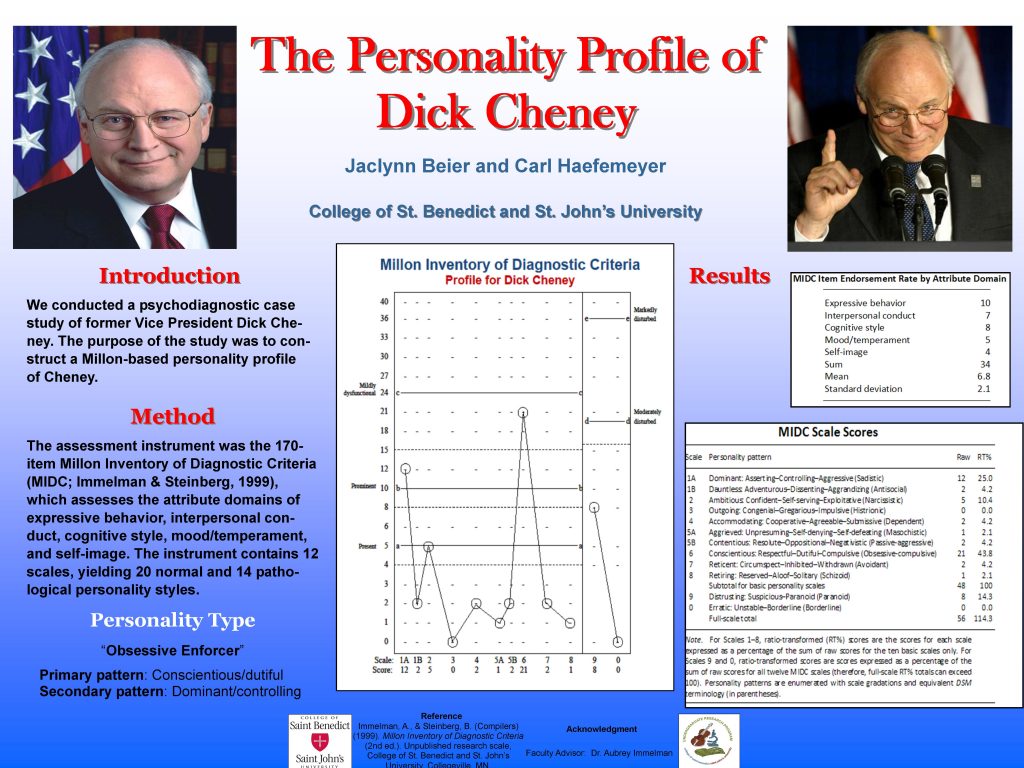
Aubrey Immelman, Jaclynn Beier, and Carl Haefemeyer
Unit for the Study of Personality in Politics
August 2009
Abstract
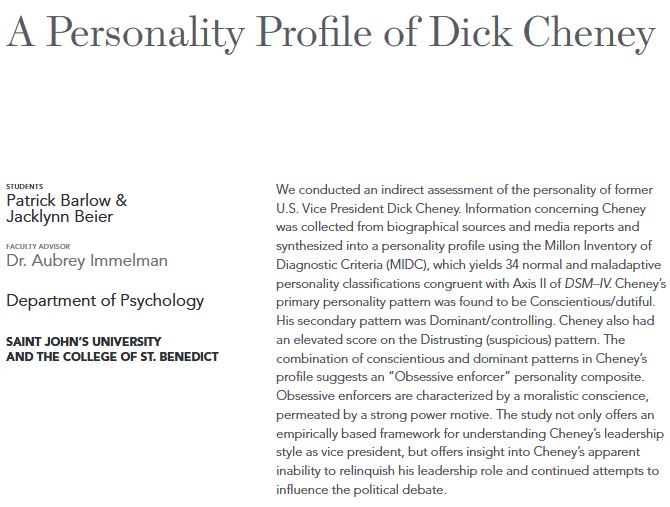
We conducted a remote psychological assessment of former U.S. vice president Dick Cheney in spring and summer 2009, mining open-source data in the public domain. Information concerning Mr. Cheney was collected from media reports and synthesized into a personality profile using the second edition of the Millon Inventory of Diagnostic Criteria (MIDC), which yields 34 normal and maladaptive personality classifications congruent with Axis II of DSM-IV.
The personality profile yielded by the MIDC was analyzed on the basis of interpretive guidelines provided in the MIDC and Millon Index of Personality Styles manuals. Cheney’s primary personality pattern was found to be Conscientious / dutiful. His secondary pattern was Dominant / controlling. Cheney also had an elevated score on the Distrusting (suspicious) pattern; however, it did not reach a diagnostically relevant scale elevation.
Leaders with an amalgam of Conscientious (obsessive) and Dominant (aggressive) patterns such as those evident in Cheney’s profile are best characterized as obsessive enforcers.
Obsessive enforcers are characterized by a moralistic conscience, permeated by a strong power motive. A stickler for rules and propriety, they are unrestrained in discharging their hostile impulses against those whom they find contemptible — ostensibly in the public interest. Not only do they act as though they have a monopoly on divining right and wrong, these personalities also believe they have a right and the obligation to control and punish transgressors, and that they are uniquely qualified to determine how punishment should be meted out.
Although obsessive enforcers operate under the guise of legitimate socially sanctioned roles to serve the public interest, the deeper motives that spur the aggressive enforcing actions of leaders with this personality style are of questionable legitimacy, given the extraordinary force with which they are willing to mete out condemnation and punishment. In the context of public service, the trademark characteristic of obsessive enforcers is first to search out rule-breakers and perpetrators of infractions that fall within the purview of their socially sanctioned role, and then to exercise what they view as their legitimate powers to the utmost.
The modus operandi of the obsessive enforcer invariably provokes opposition and resistance, which in turn incites and perpetuates ever-stronger countermeasures against real and perceived enemies. Their resulting “bunker mentality” may mimic a paranoid orientation, but more likely is simply a manifestation of hardball politics in the service of an obdurate, relentless, uncompromising, no-holds-barred striving to preserve and consolidate personal power and control.
In public life the fatal flaw of the “obsessive enforcer” leadership style is that, in carrying out their duties, these leaders may find it difficult to restrain the emotions that drive their controlling behaviors. Ultimately, dominating everything and everyone may become their single-minded goal, at the expense of exercising their responsibilities in a prudent, measured, self-restrained manner.
The major political implication of the study is that it sheds light on the extraordinary degree of power and influence that Vice President Cheney wielded in the Bush administration, and the former vice president’s apparent reluctance to follow the lead of former President George W. Bush in departing from the political arena upon completing his term of office.
Related study

FROM THE ARCHIVES: One Year Ago Today — August 10, 2008

One year ago today, on the 27th day of my campaign against U.S. Rep. Michele Bachmann in Minnesota’s 6th Congressional District, I featured a St. Cloud Times news report about the first leg of my 100-mile walking tour of the Sixth District, from Freeport to St. Joseph, Minn.
Leave a Reply
You must be logged in to post a comment.

August 15th, 2009 at 5:39 pm
Cross-posted from the Washington Post at http://www.washingtonpost.com/wp-dyn/content/article/2009/08/12/AR2009081203306.html
My research team at the Unit for the Study of Personality in Politics recently completed a six-month project to develop a psychological profile of former Vice President Dick Cheney, for the purpose of acquiring a deeper understanding of Mr. Cheney’s pivotal role in the Bush administration.
An abstract of the study is available at http://www.immelman.us/news/dick-cheney-personality-profile/
Upon reading Barton Gellman’s article (“Cheney uncloaks his frustration with Bush”) in the Aug. 13, 2009 issue of the Washington Post, I was astonished by the degree to which key points in his report substantiated core findings of our psychological investigation of Dick Cheney.
Note: Pertinent parts of Gellmann’s article are excerpted at http://www.immelman.us/news/cheney-profile-in-the-works/
October 24th, 2009 at 10:02 pm
[…] Dick Cheney Personality Profile (Aug. 10, 2009) […]
May 24th, 2010 at 10:58 am
[…] The profile reveals that Dick Cheney has an amalgam of conscientious (obsessive) and dominant (aggressive) personality patterns, suggesting an “obsessive enforcer” leadership type. […]
May 26th, 2010 at 3:41 am
[…] Dick Cheney Personality Profile (Aug. 10, 2009) […]
August 9th, 2010 at 2:27 pm
[…] One year ago today, I announced the impending release of the results of a study of the political personality of former U.S. vice president Dick Cheney, conducted at the Unit for the Study of Personality in Politics. […]
August 10th, 2010 at 11:50 pm
[…] Dick Cheney Personality Profile […]
February 15th, 2011 at 8:53 am
[…] The Personality Profile of Vice President Dick Cheney […]
May 13th, 2011 at 7:41 pm
[…] Dick Cheney Personality Profile (Aug. 10, 2009) […]
May 23rd, 2011 at 1:56 am
[…] His psychological profile reveals that Dick Cheney has an amalgam of conscientious (obsessive) and dominant (aggressive) personality patterns. […]
August 10th, 2011 at 3:29 am
[…] The political personality of former U.S. vice president Dick Cheney […]
August 11th, 2011 at 2:40 am
[…] Dick Cheney Personality Profile […]